
Crafting Killer Blog Content: Your Ultimate Guide to Unforgettable Posts

Greetings, fellow bloggers and aspiring content creators! If you’ve landed on this page, chances are you’re passionate about elevating your blogging game and producing content that truly resonates. This article is part two of a comprehensive series designed to share invaluable insights and strategies I’ve gathered about effective blogging. Our first installment delved into the intricacies of blog design, laying the foundational aesthetics for your online presence. While a visually appealing blog is crucial, its true power lies within its content. I highly recommend reviewing Part One and implementing its tips before diving into the profound world of content creation we’re about to explore.
Content is King: Why Your Blog Posts Must Reign Supreme
Let’s shift our focus to the heart of any successful blog: its content. You’ve likely heard the enduring mantra, “Content is King,” countless times. This isn’t just a catchy phrase; it’s the undeniable truth that underpins digital success. No matter how impeccably designed your blog is, or how vigorously you promote it across various platforms, if your content fails to captivate and inform, visitors will quickly lose interest and seek alternatives. Exceptional content is the magnet that attracts readers, keeps them engaged, encourages them to return for more, and inspires them to share your work with their networks. Your primary objective should always be to consistently produce high-quality, compelling content that provides genuine value to your audience.
Outstanding blog content is the secret sauce that distinguishes your voice in a crowded digital landscape. It transforms a simple blog into a recognized brand, fostering trust and loyalty among your readership. More than just attracting eyeballs, killer content can unlock unforeseen opportunities, from collaborations and speaking engagements to product development and beyond. But before we delve into what makes content phenomenal, let’s identify some common pitfalls that can undermine even the most promising blogging efforts. Understanding what to avoid is just as crucial as knowing what to embrace.
3 Types of Blog Content to Steer Clear Of for Sustainable Growth
To truly stand out, we must first recognize and avoid the content traps that hinder growth and engagement. These types of content can severely damage your blog’s credibility, readership, and search engine ranking. Let’s explore three critical content types you should actively avoid.
1. Content That Is Too Short and Lacks Depth
In the realm of search engine optimization (SEO), length often correlates with perceived value and authority. Search engines like Google tend to favor blog posts that offer comprehensive information, typically ranging between 700 to 1500 words, or even longer for detailed guides. While there are exceptions for quick updates or specific news, consistently publishing posts of only a few sentences can signal to search engines that your content lacks substance or comprehensive value. These “thin” posts are less likely to rank well, receive organic traffic, or satisfy reader intent.
Longer content allows you to delve deeper into a topic, explore various facets, answer potential reader questions, and naturally incorporate a wider range of relevant keywords. This comprehensive approach establishes your blog as an authoritative resource. To check your word count, you can easily copy and paste your text into a tool like Microsoft Word or utilize a free online word counting tool. If your blogging platform doesn’t provide an automatic word counter, these tools are indispensable for ensuring your posts meet the recommended length for optimal SEO performance and reader engagement. Remember, the goal isn’t just arbitrary length, but comprehensive coverage.
2. Content Copied Directly from Other Websites
Originality is paramount in the blogging world. While it’s perfectly acceptable, and often encouraged, to quote relevant passages or reference information from other reputable sources, your blog should never consist primarily of content copied and pasted from elsewhere. This practice, known as plagiarism, carries severe consequences. Firstly, it prevents you from establishing yourself as an expert or authority in your chosen niche. Readers and search engines alike seek unique perspectives and fresh insights, not regurgitated information.
Secondly, plagiarism can lead to significant ethical and legal repercussions. You risk damaging your reputation, incurring SEO penalties from search engines that detect duplicate content, and even facing copyright infringement lawsuits. “Copy and paste” blogging stifles your creativity and severely limits your growth potential. A true blogger aims to evolve beyond their platform, potentially writing books, developing online courses, or speaking at industry events. Such ambitions are unattainable if your work lacks originality and your unique voice. Invest in creating your own unique content to build a sustainable and respected brand.
3. Content That Is Excessively Long and Unengaging
While we’ve emphasized the importance of adequate content length, it’s equally crucial to avoid the opposite extreme: content that is long merely for the sake of being long, without offering sustained value or engagement. A lengthy post filled with fluff, redundant phrases, or poorly structured arguments will quickly bore your readers and cause them to abandon your page. The goal is depth and comprehensiveness, not arbitrary word count.
Every sentence in your blog post should contribute meaningfully to your message. Before publishing, critically evaluate your writing: “Would I genuinely enjoy reading this if I encountered it on another blog?” “Is every paragraph essential, or could some ideas be condensed or eliminated?” Strive for conciseness and clarity, ensuring that even lengthy posts maintain a brisk pace and engaging tone. If a post feels stretched or uninteresting, save it as a draft. Revisit it later with fresh eyes, seeking ways to refine, tighten, and enrich its core message. Quality trumps quantity every time when it comes to reader retention.
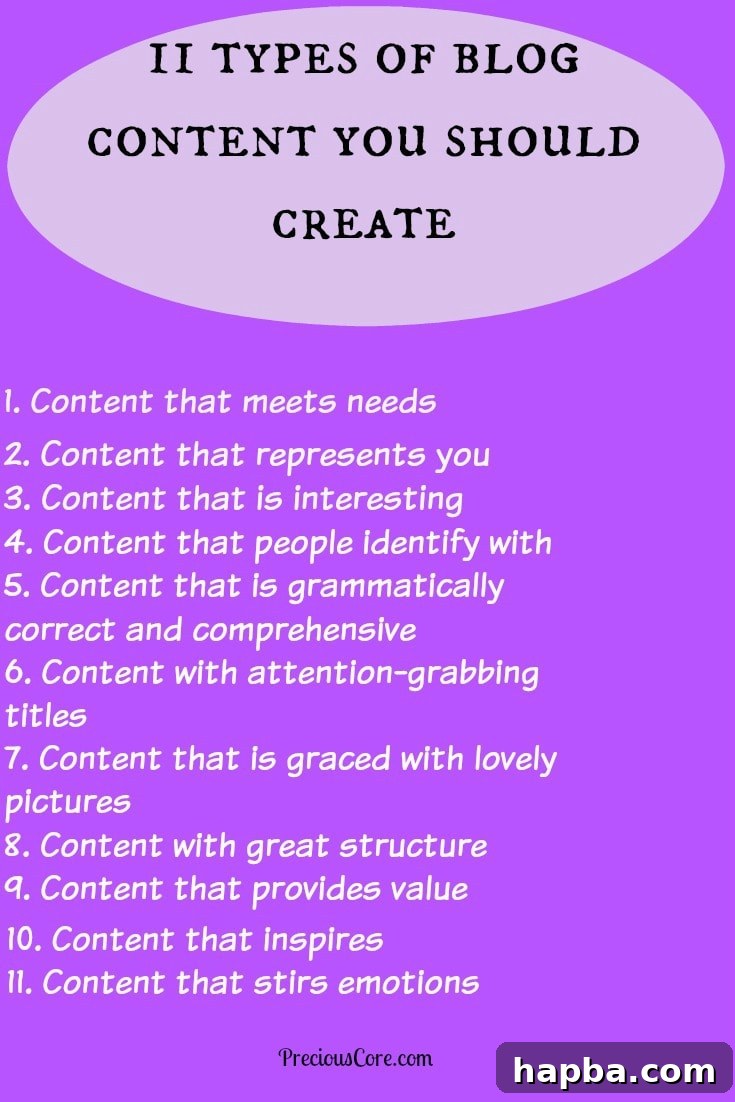
11 Essential Types of Blog Content You Should Be Creating
Now that we’ve covered what to avoid, let’s pivot to the positive: the kinds of content that will truly make your blog shine and attract a loyal readership. Crafting phenomenal content is an art, but it’s an art that can be learned and honed. Here are eleven powerful types of content that should form the cornerstone of your blogging strategy:
1. Content That Meets Specific Reader Needs
At its core, great content solves problems or answers questions. One of the most effective strategies for building a loyal audience is to create content that directly addresses the real-world needs of your target audience. When I started blogging, I didn’t initially envision recipe writing as a major component. However, my passion for food led me to share recipes, and the feedback was overwhelmingly positive. Readers appreciated the clear, step-by-step directions, which met their need for practical culinary guidance. This experience taught me that providing actionable help is a powerful way to foster reader appreciation and repeat visits.
Consider what unique needs you can fulfill within your niche. Are you providing health tips, style advice, career guidance, fitness routines, or daily inspiration? Whatever your focus, ensure your content empowers readers to achieve a specific goal or overcome a challenge. To maximize your reach, use tools like the Google Keyword Planner or BuzzSumo to identify popular search terms related to your topic. Incorporating these keywords naturally into your posts will help people who are actively searching for solutions find your valuable content.
2. Content That Authentically Represents Your Unique Voice
With millions of blogs covering virtually every topic imaginable, the chances are that whatever you plan to write about has already been discussed. What makes your content stand out isn’t just the topic, but *your* unique take on it. Infuse your personality into every post, letting your authentic voice and distinctive perspective shine through. Your personal story, experiences, and opinions are what truly differentiate you.
For instance, instead of merely presenting a generic Fried Rice recipe, share what makes *your* Fried Rice special. Was it a dish you perfected during a specific time in your life? Did it become a staple at family gatherings, prompting relatives to keep visiting just for that plate of food? Sharing these personal anecdotes creates an emotional connection with your readers that no generic article can replicate. Your individuality is your superpower in the blogging world; leverage it to build a unique brand that resonates deeply with your audience.
3. Content That Is Inherently Interesting and Captivating
Some of the most cherished feedback I’ve received is from readers who claim they usually dislike reading long articles but found themselves engrossed in my posts, only realizing their length at the very end. This is the magic of truly interesting content: it draws readers in with compelling language and paints vivid mental pictures. You might have brilliant ideas, but their presentation is paramount. If engaging writing is a challenge, make it a habit to read widely from acclaimed authors and highly-ranking articles. Immerse yourself in different writing styles to understand what makes them captivating. Seek out “creative writing ideas” online to spark your imagination and refine your prose. The goal is to make every paragraph a delight to read, keeping your audience hooked from start to finish.
4. Content That Fosters Identification and Relatability
Few things are as powerful as a reader exclaiming, “You just told my story!” People are inherently drawn to narratives and experiences that mirror their own. Sharing your vulnerabilities and personal struggles, when appropriate, creates a profound sense of connection and empathy. When readers see themselves reflected in your words, they feel less alone and more understood. This type of content builds a strong community around your blog, fostering trust and loyalty.
Don’t shy away from sharing personal experiences, whether past or present, that many others can relate to. Your story, shared authentically, can serve as a key that unlocks others from their own metaphorical prisons of isolation or misunderstanding. It’s about creating a shared human experience that transcends the digital screen, making your blog a safe and welcoming space for honest reflection.
5. Content That Is Grammatically Correct, Clear, and Comprehensive
While you don’t need to be a linguistics professor, adhering to basic grammatical rules and ensuring clarity in your writing is non-negotiable for maintaining credibility. Readers quickly lose confidence in content riddled with errors or obscure phrasing. I’ve encountered blogs where I struggled to grasp the author’s message, leading to immediate disengagement. Your posts must be clear, coherent, and easily understandable.
If writing feels daunting, try imagining you’re explaining your ideas to a close friend or family member. How would you simplify complex concepts? How would you structure your thoughts for maximum clarity? Then, write it down! To assist with proofreading, consider using invaluable tools like Grammarly. This free application can be downloaded to your computer and meticulously highlights grammatical errors, spelling mistakes, and stylistic issues, significantly enhancing the professionalism and readability of your content. Flawless grammar builds trust and ensures your message is received precisely as intended.
6. Content Featuring Attention-Grabbing Titles
Your blog post title is often the first, and sometimes only, impression you make on a potential reader. A compelling title is crucial for enticing clicks and drawing readers into your content. It needs to be both creative and honest, accurately reflecting what readers will find within your post. Nothing is more frustrating than a misleading title that promises one thing but delivers another. Effective titles share several key characteristics:
- Concise: Aim for 10 words or less to ensure readability and optimal display across various platforms.
- Intriguing: Spark curiosity and make readers want to learn more.
- Guiding: Clearly indicate the content type or benefit, often using numbers or “how-to” phrases (e.g., “10 Ways to Boost Your Productivity,” “How to Master Blog Photography”).
Crafting effective titles is an art form that directly impacts your click-through rate and overall blog traffic. Invest time in brainstorming multiple options for each post to ensure your title is as powerful as your content.
7. Content Graced with Visually Appealing Pictures
In today’s visually-driven world, images are not merely decorative; they are integral to compelling blog content. Irresistible visuals break up text, convey emotion, and significantly enhance reader engagement. The right pictures can transform a good blog post into a phenomenal one. Whenever possible, prioritize using your own original, high-quality photographs over generic stock images or pictures pulled from Google Images without proper attribution. Developing a habit of taking photos of interesting things around you can build a valuable library of unique visuals for future posts.
While a DSLR camera can certainly elevate your photography, it’s not a prerequisite. The best camera is always the one you have with you, so leverage your smartphone diligently. Furthermore, a plethora of excellent, free online tools are available for photo editing and graphic design, serving as fantastic alternatives to professional software like Photoshop. Consider exploring:
- PicMonkey
- Canva
- Pixlr
Remember to optimize your images for web use (appropriate size and format) and include descriptive alt text for improved SEO and accessibility.
8. Content with a Clear and Logical Structure
A well-structured blog post guides your reader seamlessly through your ideas, ensuring maximum comprehension and engagement. Every effective post should adhere to a basic narrative arc:
- A Strong Beginning (Introduction): This is your hook. Start with an engaging question, a compelling quote, a personal anecdote, an interesting fact, or a relatable struggle. The introduction’s primary goal is to immediately draw the reader in and make them eager to read the rest of your post.
- A Detailed Middle (Body): This forms the core of your post, where you present all your arguments, explanations, examples, and supporting details. Break down complex ideas into digestible paragraphs, use subheadings to organize distinct points, and incorporate bullet points or numbered lists for clarity.
- A Conclusive End (Conclusion/Call to Action): The conclusion should summarize your main points, offer a final thought or takeaway, and ideally, circle back to your introduction. It’s also an excellent place to include a clear call to action (CTA), such as asking a question for comments, encouraging readers to share, or directing them to related content.
This logical flow ensures your content is not only informative but also highly readable and impactful.
9. Content That Consistently Provides Actionable Value
At the heart of every successful blog lies the principle of providing genuine value to its readers. Your content should offer tangible benefits, whether it’s a solution to a problem, a comprehensive resource list, practical tips, or profound insights. Before publishing, always ask yourself: “What will my readers gain after dedicating their time to this post?”
Approach each blog post as an opportunity to offer free, valuable resources to your audience. Pour your passion and expertise into what you write, focusing on how you can best serve your readers. This generous approach—giving, giving, and giving again—is where true fulfillment in blogging lies. When readers consistently find value in your work, they become loyal followers, evangelists for your brand, and a thriving community around your blog.
10. Content That Inspires and Motivates
Beyond providing information, some of the most memorable content moves us emotionally and intellectually. Your blog posts have the power to inspire readers, whether by reminding them of life’s preciousness, validating their struggles, or encouraging them to pursue their dreams. Content that ignites positive energy or sparks a sense of possibility leaves a lasting impression.
Write with the intention to uplift, motivate, and empower. Share stories of resilience, highlight paths to personal growth, or offer perspectives that encourage optimism. When your content inspires, it doesn’t just inform; it transforms, leaving readers feeling invigorated and ready to take on new challenges.
11. Content That Evokes Strong Emotions
Emotion is a powerful catalyst for memory and engagement. The most unforgettable movies, books, and speeches are those that make us laugh, cry, ponder, or feel a surge of anger or joy. Similarly, powerful blog content stirs emotions within your readers. It could be humor that brings a smile, a poignant story that brings tears, or a passionate argument that ignites a sense of purpose.
People may not remember your exact words days or weeks later, but they will vividly recall how your blog post made them feel. Craft stories and arguments that tap into universal human emotions. This not only makes your content more memorable but also strengthens the bond between you and your audience, creating a deeper, more personal connection.
The 3 Rs: Your Blueprint for Creating Killer Blog Content
Understanding the characteristics of great content is the first step; the next is applying practical strategies to produce it consistently. Here are three crucial “Rs” that form the foundation of an effective content creation process:
1. Research Extensively
Effective content creation is always built upon a solid foundation of research. My preferred approach is to first write an initial draft, capturing all my core ideas and insights without interruption. This prevents the loss of spontaneous thoughts. Following this, I delve into thorough research. I investigate similar articles written on the topic, explore various perspectives, and gather supporting data or examples. This iterative process of drafting and then researching not only validates my initial ideas but also provides fresh inspiration, expands my knowledge, and allows me to refine and enrich my post with greater depth and authority. Research ensures your content is not only original but also accurate, comprehensive, and well-informed.
2. Read Through Diligently (and Repeatedly!)
One of the gravest mistakes a blogger can make is rushing to publish a post without thorough review. The editing phase is just as critical as the writing itself. After completing your draft, step away from it for a few hours, or even a day, if possible. Return with fresh eyes and read through your entire post. Then, read it again. And perhaps one more time. Each subsequent read-through often reveals subtle grammatical errors, awkward phrasing, logical gaps, or opportunities for improvement that were initially missed. Reading your content aloud can also help you catch clunky sentences and improve the overall flow. This meticulous review process ensures your published content is polished, professional, and free of distracting errors.
3. Respond and Engage with Your Audience
While this “R” isn’t directly about creating the content itself, it’s absolutely vital for maximizing the impact of your efforts post-publication. Blogging is a two-way street. Making a conscious effort to respond thoughtfully to your readers’ comments, questions, and feedback demonstrates that you are a real person, present and engaged. This interaction builds a vibrant community around your blog, fostering loyalty and making readers feel valued. Beyond crafting excellent posts, successful blogging hinges on cultivating meaningful connections with your audience. Engaging in conversations shows appreciation, reinforces your authority, and provides invaluable insights into what your readers truly want and need, informing your future content strategy.
Remember, every single blog post you publish could be the very first interaction someone has with your blog. Therefore, strive for excellence in every piece of content you create. Make it count.
Here are some final considerations to help you on your journey:
- Bookmark This Page: Keep this guide handy for future reference. Before hitting “publish” on any new post, use it as a checklist to evaluate your content against these best practices.
- Share the Knowledge: If you found these tips helpful, consider sharing this post with your social media followers. Someone in your network might greatly benefit from these insights on crafting compelling blog content.
- Stay Tuned: I have much more to share about the art and science of blogging. Be sure to check back for future installments in this series, offering even more detailed advice and strategies.
My sincere hope is that this comprehensive guide empowers you to reach unprecedented heights in your blogging endeavors, inspiring you to create content that not only attracts but truly captivates your audience.
What specific types of blog content do you find most appealing or challenging to create? Let’s continue the conversation in the comments section below!